

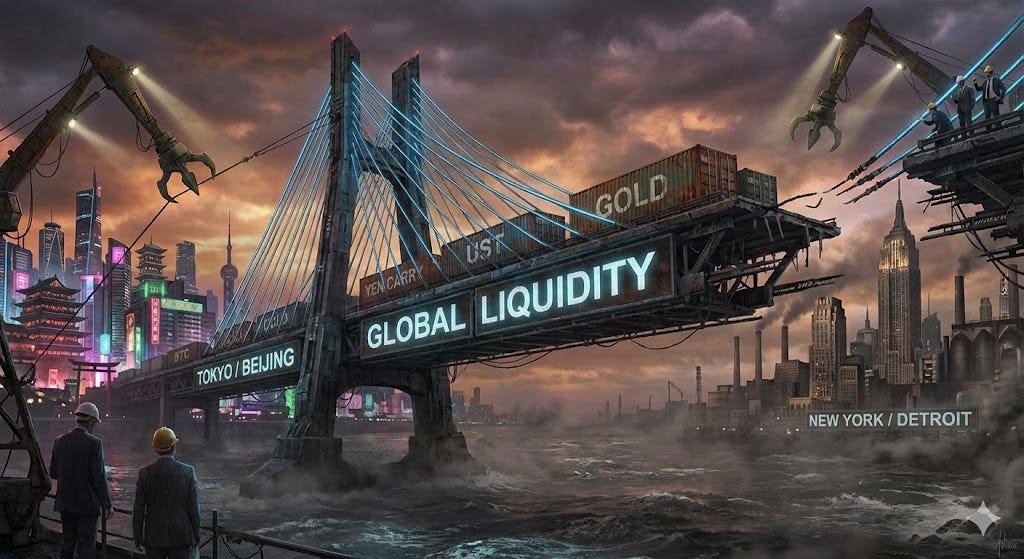
Welcome to MacroMashup — where we track the plumbing beneath the headlines.
We focus on funding markets, sovereign balance sheets, and the structural flows that determine which assets become collateral — and which become narratives.
If you’re new here, subscribe for weekly macro breakdowns that connect policy, capital flows, and portfolio positioning — before the consequences become obvious.
Calm Surface, Cracked Foundations
This week’s macro tape looks calm on the surface.
The Fed is in blackout mode, parked at 3.50–3.75%. No new dot plot. No press conference shock. Just a steady drip of inflation and labor data for markets to over-interpret.
There is good and bad in the delayed non-farm payrolls numbers:
Good enough to push back on imminent recession/hard-landing narratives (headline beat, unemployment down, participation up).
Not good enough to erase the story of a materially cooled labor market once you incorporate the 2025 revisions (-900k) and very narrow sector leadership.
For markets: bullish for near-term risk sentiment vs “jobs scare” scenarios, but mildly bearish for front-end duration versus hopes of rapid cuts, with a tilt toward a slow-grind softening rather than a cliff.
January is a volatile month, and not that reliable.
Equities rotate instead of breaking, though the AI scare continues to create anxiety at the white-collar end. The market is beginning to try picking winners and losers.
The 10-year chops around.
Nobody says they’re de-risking — but positioning keeps getting tighter.
Then geopolitics delivers peak 2026 energy: a political standoff over a literal bridge.
The Gordie Howe International Bridge — one of the most important trade crossings between Detroit and Windsor — is now a bargaining chip. The White House is threatening to block its opening unless the U.S. gets a “better deal,” up to and including revisiting permits.
When a concrete span becomes leverage, you’re being reminded of something bigger:
Critical infrastructure is no longer sacred.
It’s collateral.
Under the surface, the real story isn’t about bridges.
It’s about who funds what — and who stops funding it.
In this week’s Deep Dive for paid readers, we examine:
Why the yen carry trade just lost its training wheels
Why Japan’s bond market is no longer “sleepy”
Why China is quietly telling banks to temper Treasury exposure
And what happens when sovereign duration stops feeling frictionless
Bitcoin bled lower this week, behaving less like digital gold and more like a liquidity-sensitive risk asset. Hard assets are beginning to diverge — some are collateral, some are narrative.
The system is quietly repricing the difference.
