Scoring The Grid
A Framework for the AI Infrastructure Cycle
A bottleneck you cannot measure is a bottleneck you cannot trade.
MacroMashup Briefing
This Week’s Macro Overview
Monday morning: Truth Social. Before the open.
Trump: “Very good and productive conversations” with Iran.
Dow +631. Brent -11%. Biggest single-day oil drop since March 10.
Tuesday: “We are in negotiations right now.”
Wednesday: 15-point peace plan reportedly sent via Pakistan.
HY spreads: 370 → 319 bps. Brent below $100 for first time in two weeks.
Markets exhaled.
Thursday: it all reversed.
Trump walked it back at a Cabinet meeting. Told Iran to “get serious” before it’s “too late.”
Tehran formally rejected the US proposal.
Fresh strikes exchanged. The five-day strike pause expires Saturday.
Brent snapped back above $100. WTI above $94.
S&P -1.5%. Nasdaq -2%. Meta -7% on a jury verdict finding social media harmful to children.
Memory chips crushed after Alphabet published AI efficiency research that threatens the whole build-more-silicon thesis.
Treasury yields spiked. The 10-year pushed toward 4.40%.
The ceasefire bounce lasted 72 hours.
Now look at what didn’t move.
Iran denied it all week. Categorically. No negotiations underway.
Iran’s counterproposal: five points. One of them is control of the Strait of Hormuz.
That’s not a negotiating position. That’s a rejection dressed as a proposal.
Now look at the force posture.
Marine Expeditionary Forces deploying to the region.
82nd Airborne flying in.
Saudi Arabia and UAE moving closer to joining the conflict.
You don’t stage an airborne division if you’re closing a deal.
And you don’t tell the other side to “get serious or face consequences” if talks are going well.
The timing was always suspicious.
Truth Social post drops before the Monday open. Market heading for another ugly session. Post reverses it instantly.
We’ve seen this before.
This wasn’t de-escalation. It was a market intervention.
The ceasefire bounce was a step up before a bigger step down.
Thursday was the step down.
Saturday may be the next one.
What hasn’t changed:
Hormuz is still functionally closed. To anyone Iran is not prepared to even charge a toll.
P&I insurers have not reinstated coverage.
Oil at $101 is not $113. But it’s not $94 anymore either. The relief rally in crude is already unwinding.
Gold crashed from $5,187 to $4,480. Breaking below $4,500 now. The structural case hasn’t changed — fiscal deterioration, real rate uncertainty, energy-driven inflation. But the liquidation is real.
OECD just revised its US 2026 inflation forecast to 4.2%. The Fed projected 2.7% last week. Someone is very wrong.
HY at 330 bps. Wider than Wednesday’s 319. The compression already reversing.
Apollo’s $15B credit fund hit with redemptions at 2x its quarterly cap. Jefferies flagged private credit stress in earnings today. The plumbing is cracking.
The market moved on narrative this week.
Not on structure. Not on physics.
When the physical and the narrative diverge, bet on the physics.
The bounce is over. The resolution is not coming. Position accordingly.
What happened to the U.S. Energy Grid?
Over the past three weeks, we’ve built a simple thesis:
The electrical grid is becoming the binding constraint on AI expansion.
Interconnection queues are clogged.
Wait times are measured in years.
And capital that cannot find power is starting to move.
Why it matters
Most of the market is still framing AI as a semiconductor story.
More chips.
More compute.
More data centers.
But none of it works without electricity.
And electricity systems do not scale at the speed of software.
Which creates a different kind of constraint:
Not visible in model performance.
Not visible in chip supply.
But embedded in physical infrastructure.
The Missing Layer
The constraint is visible.
But it is not measurable in a way investors can actually use.
You can see pieces of the bottleneck.
You cannot compare regions.
You cannot track change.
You cannot tell where it is tightening — or where it is breaking.
And if you cannot measure it, you cannot trade it.
🚨 Important Update for MacroMashup Subscribers
On March 31, we are launching a new publication:
The AI Grid Report
The AI economy runs on the grid.
The grid does not scale at the speed of AI.
Most AI analysis focuses on:
chips
models
capital flows
We focus on something else:
The infrastructure constraints that determine whether those assumptions can actually materialize.
What we will track
Each week:
grid constraint signals
AI load collisions
time-to-build gaps
regional readiness
capital implications
Each month, premium members receive:
AI Grid Constraint Index™
A structured assessment of where AI capacity can scale —
and where infrastructure timelines create friction.
What this is (and what it is not)
This is not a market newsletter.
This is not a technology digest.
This is:
AI Infrastructure Constraint Intelligence
The bet
If we are right, then parts of today’s AI growth projections are structurally incompatible with current grid expansion timelines.
What happens next
MacroMashup will be paused until further notice while we focus fully on building The AI Grid Report, our new core focus.
This is a structural shift — not just another theme.
We begin March 31.
Join us here:
A Note for MacroMashup paid subscribers
If you are currently on a paid MacroMashup subscription:
Please look out for a message in your email or subscriber chat with details on your transition.
A final note to all subscribers
We’ve removed the paywall on this issue.
This week’s deep dive
Neil’s Notes
In this issue, we move from thesis to structure.
We introduce a way to track the grid constraint itself — not as a narrative, but as a system.
Inside, we break down:
the variables that define grid bottlenecks
how constraint shows up across regions
where data center pipelines are already colliding with infrastructure limits
and how capital is positioning around those constraints
This is the transition point:
From observing the bottleneck…
to being able to track it.
↓ Read the full deep dive
From bottleneck to system
Over the past three weeks, we’ve shown that the electrical grid is not just part of the AI story.
It is the constraint shaping it.
Projects are waiting years to connect.
Withdrawal rates are rising.
Demand is accelerating faster than infrastructure can respond.
But identifying a bottleneck is only the first step.
The real question is:
How do you track it?
The problem with how the market sees the grid
Most investors are still looking at the grid the wrong way.
They look at:
generation capacity
renewable buildout
policy announcements
headline investment numbers
All of which matter.
None of which tell you what actually matters most:
Where power can connect — and when.
Because the constraint doesn’t show up in capacity.
It shows up in timelines.
Where the constraint actually lives
The constraint isn’t demand.
It’s the system that determines whether power can actually be delivered.
And that system looks very different depending on where you build.
This is why AI infrastructure isn’t scaling evenly.
It’s not a technology problem.
It’s a grid access problem.
And increasingly, it’s a geography problem.
The bottleneck is not theoretical.
It sits inside:
interconnection queues
permitting timelines
transmission build delays
generation retirement schedules
Each of these moves on a different clock.
And none of them are aligned with the pace of AI demand.
This is why the system feels like it is “almost working” —
while at the same time failing to deliver where it matters most.
What this changes
Once you start looking at the grid through timelines instead of capacity, the entire AI infrastructure story shifts.
You begin to see:
why certain regions attract capital — and then stall
why projects get announced faster than they get built
why fully constructed facilities sit idle waiting for power
why capital starts to move across geographies
This is not a supply problem.
It is a timing problem.
And timing is what determines returns.
Why this required a new system
The data to understand this exists.
But it is fragmented, inconsistent, and difficult to compare.
You cannot easily answer:
Which regions are actually buildable today?
Where are timelines improving — or deteriorating?
Where is capital early versus already trapped?
And without that, you cannot form a clear view on where AI infrastructure will actually scale.
So we built a way to track it.
Introducing AI Grid Constraint Index™
Not as a model.
Not as a forecast.
But as a structured way to measure the constraint itself.
Each month, the AI Grid Constraint Index™ provides a clear assessment of:
where infrastructure timelines are tightening
where they are easing
and where AI capacity can realistically scale
It is designed to do one thing:
Turn fragmented grid data into a trackable signal for investors.
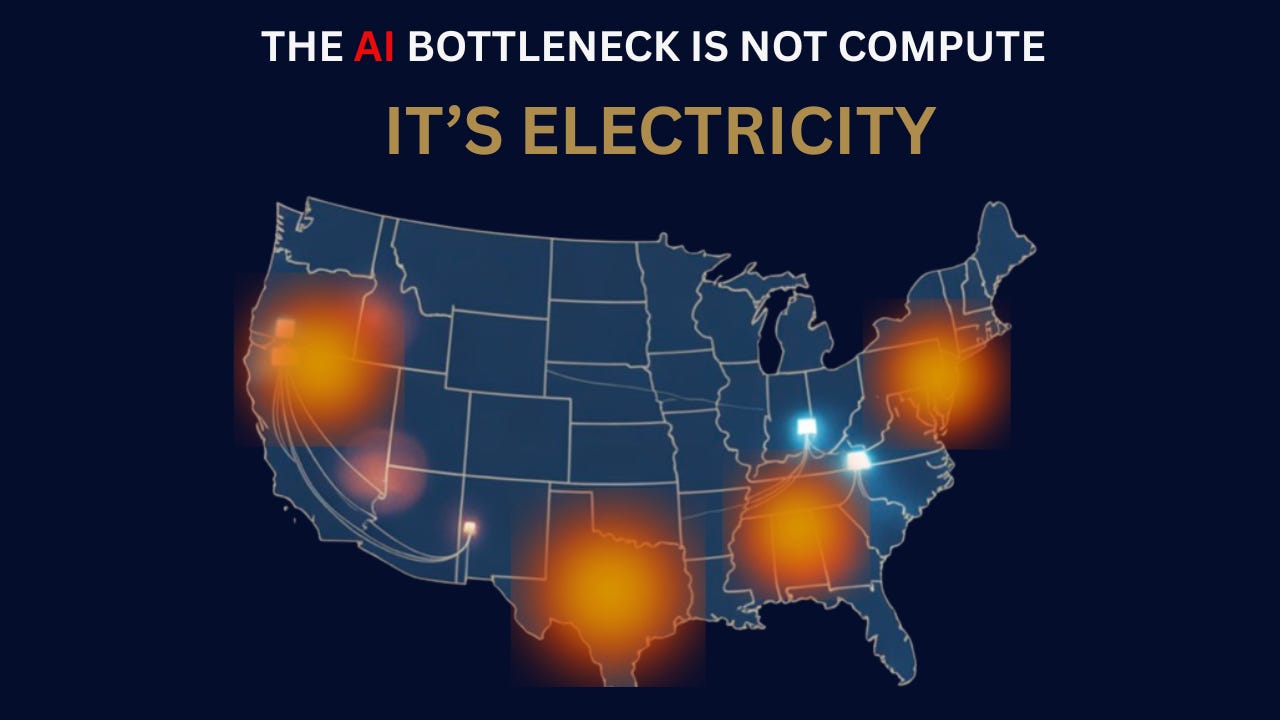
The constraint isn’t theoretical. It’s visible in how capacity is actually distributed—and where it gets stuck.
The imbalance is immediate.
Capacity is concentrated, but not deployable—trapped in queues, delays, and unpowered assets.
That gap is structural. It’s a function of how interconnection works in the U.S.
Why this became its own publication
As we built this, one thing became clear:
This is not a side topic.
It is not a subsection of macro.
It is a system that needs to be tracked continuously.
Because the signal moves.
Queues shift.
Projects drop out.
Timelines extend.
Capacity changes.
And each movement changes where capital flows next.
That cannot be captured in occasional analysis.
It requires ongoing tracking.
What happens next
That is why we are launching:
The AI Grid Report
Subscribe here:
Each week, we will publish:
a public briefing on the evolving constraint
a focused analysis on one part of the system
Each month, premium members will receive:
the updated AI Grid Constraint Index™
a structured view of where the system is tightening or loosening
and what that means for capital, infrastructure, and energy markets
The shift
We are moving from:
Explaining the bottleneck
to
Tracking it in real time
Why this matters now
The AI buildout is accelerating.
But the infrastructure behind it is not.
Which means the gap between expectation and reality is widening.
And that gap is where:
projects stall
capital reroutes
and opportunities emerge
The bottom line
The constraint is no longer hidden.
The question is whether you can see it clearly enough to act on it.