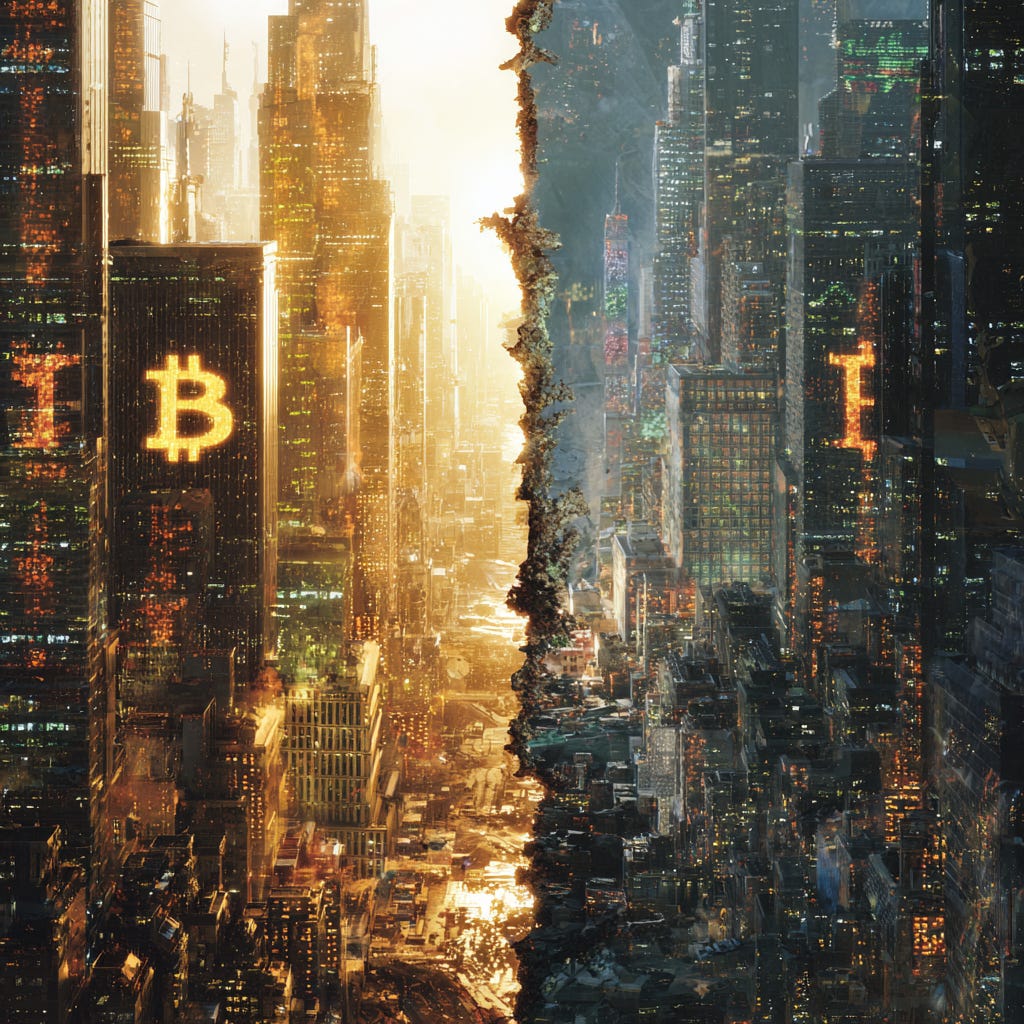
From Six-Figure Bitcoin to a Split Market: The Macro Signals of November
November wasn’t subtle. It was a month where macro stopped hinting and started speaking loudly: liquidity tightened, politics drifted into Fourth-Turning territory, AI ran into physical grid limits, and markets split cleanly into winners and losers under the surface.
This Retro Edition pulls together all four of November’s Friday briefings into one coherent narrative so you can see the full picture — from six-figure Bitcoin tests to a sharply diverging, K-shaped market. Here’s what happened, why it mattered, and how to position heading into December.
If you’re new here, welcome to MacroMashup — where we decode U.S. macro, markets, policy, and energy in under 10 minutes so you can invest with clarity instead of chaos.
If you find this useful, please take a moment to subscribe and support the channel. Your subscription helps us keep producing independent, signal-first analysis without noise, hype, or agendas.
WEEK 1 — Nov 7
Blue Momentum, Geopolitics on Pause & the $100K Bitcoin Test
The month opened with politics front and center.
What happened:
Surprise “blue” wins across several key races signaled voter willingness to experiment outside traditional lines.
The U.S.–China relationship entered a brief détente — not friendship, but damage control.
FERC introduced quiet but monumental grid reforms that could shape the entire AI infrastructure boom for the next decade.
Bitcoin hit five figures on the way down (it’s been there ever since), testing its new narrative floor.
Nvidia continued behaving less like a stock and more like a volatility event driven by options flow.
Why it mattered:
Week 1 made one thing clear: politics, energy infrastructure, and crypto can no longer be analyzed separately. The policy backdrop now directly influences capital flows, risk assets, and energy-intensive industries like AI.
Key takeaway:
Markets still pretend politics don’t matter — until they do, all at once.
WEEK 2 — Nov 14
Liquidity Stress, Fiscal Dominance & Automation Anxiety
By mid-month, the macro story shifted from political noise to structural strain.
What happened:
Liquidity tightened and repo markets flashed early signs of stress.
U.S. fiscal deficits — running above $2T — boxed the Fed into a narrower policy corridor.
Headlines about automation, layoffs, and robotaxis drove a new narrative: labor markets aren’t cooling — they’re transforming.
Gold stole the crisis-hedge narrative back from Bitcoin.
At COP 30, world leaders quietly endorsed fossil-powered energy expansions to support AI demand.
Why it mattered:
Week 2 underscored the arrival of fiscal dominance — when deficits drive policy more than central banks do.
It also showed AI’s darker macro implication: automation shifts aren’t gradual this time; they’re exponential.
Key takeaway:
Liquidity, deficits, AI, and energy are now one conversation — not four separate ones
WEEK 3 — Nov 21
Pendulum Politics & the Return of “Improvised Economics”
Week 3 zoomed out to the global political landscape.
What happened:
Backlogged economic data finally dropped, forcing markets to re-price in real time.
U.S.–Saudi nuclear cooperation talks highlighted where the marginal barrel — and macro volatility — really lie.
Fed messaging turned chaotic: mixed signals on inflation, jobs, and future rate paths.
Risk assets on the periphery felt the pressure of shrinking liquidity.
The deeper story:
This week made the case for pendulum politics — the idea that governments are converging toward a hybrid, improvisational operating system driven by demographics and survival, not ideology.
Europe, the U.S., and China may look different on paper, but their policy responses are starting to rhyme.
Key takeaway:
Ignore the left vs right narrative. The real trend is governments mixing whatever tools keep the system upright.
WEEK 4 — Nov 28
The K-Shaped Economy & Markets That Split Beneath the Surface
The month closed with the cleanest signal of all: dispersion is the real story.
What happened:
Bitcoin drifted sideways, waiting for a macro catalyst.
Gold and silver continued quiet accumulation — a slow coil rather than a euphoric spike.
The S&P held up, but underneath, dispersion widened dramatically.
Nvidia’s price action tightened its identity as a volatility instrument, not a traditional equity.
Mixed Fed commentary set December up as a policy knife fight rather than a routine meeting.
Why it mattered:
The “K-shape” — where some sectors boom while others break — is no longer a theory. It’s the dominant pattern across spending, earnings, and asset performance.
Key takeaway:
We’re not in a boom. We’re not in a bust. We’re in a redistribution regime.
THE BIG NOVEMBER THROUGH-LINE
Across all four weeks, a clearer pattern emerges:
1. Energy is the real AI trade
AI is hitting physical infrastructure limits — and capital is waking up to the idea that the AI supercycle is, at its core, an energy supercycle.
2. Fiscal dominance is no longer theoretical
The bond market, not the Fed, is driving the agenda. Liquidity is the real macro story.
3. Politics is hybrid, not ideological
Governments are improvising. Expect more policy whiplash and fewer straight-line forecasts.
4. The market is splitting, not rallying
Averages are masking extreme divergence — the heart of today’s risk-management challenge.
HOW TO USE THIS RETRO
A simple framework for turning this into action:
Identify the theme most relevant to your portfolio
Liquidity? Energy? Policy risk? Dispersion?Revisit the Friday issue tied to that theme
One deep dive is more useful than skimming all four.Make one practical adjustment this week
Trim concentration
Add energy/infra exposure
Re-evaluate hedges
Rebalance your safe-haven stack
Small moves compound.
COMING UP IN DECEMBER
We’re watching three things closely:
How deep the liquidity stress goes before policymakers blink
Whether AI-energy projects actually break ground or get stuck in regulation
How the K-shape evolves as earnings revisions collide with labor data
December could be the month where macro “surprises” become macro “realities.”
Thank you for reading MacroMashup. Our mission is simple: help you make smarter investment decisions by connecting the dots between macro, energy, geopolitics, and markets — clearly and honestly.
If this Retro edition gave you value, please support the channel by subscribing, sharing, or forwarding it to one person who’d benefit. It’s the easiest way to help us grow and continue delivering high-impact analysis every week.